


The 2026 Operator: How operational excellence wins in any market cycle
Are you operating for 2026—or reacting to 2025?
Market cycles will always rise and fall. But the restorers who consistently win—through slowdowns, labor shortages, CAT-less years, and margin pressure—aren’t reacting to volume. They’re building operational machines designed to perform in any environment.
In this on-demand webinar, Encircle CEO Paul Donald sits down with three highly respected industry operators and advisors—Brandon Reece (FP Restoration / Floodlight Consulting), Lukas Szczurowski (Sanktum), and Josh Bachman (Violand)—to unpack what operational excellence really looks like at every stage of growth.
Rather than chasing trends or shortcuts, the conversation focuses on what top performers actually do differently: how they execute on Day-1, create consistency across teams, protect margins as they scale, and use data and technology to make better decisions—faster.
This is not a theory session. It’s a candid, operator-to-operator discussion about what works, what breaks, and what separates companies that scale profitably from those that stall.
Good afternoon, everyone. Welcome to the twenty twenty six operator webinar. My name’s Leah. I’m gonna hand things over to the CEO of Encircle, Paul Donald, and he is going to take things away for us. Thank you, Leah. Thank you for all your work putting this together. Welcome all who have joined us. This is a really exciting webinar and something that’s, you know, near and dear to my heart. When I started Encircle nearly fourteen years ago, it was really to help restorers who care about their communities, give their all, become operators. I think we all know how much the world has changed just in the past four years to five years since since COVID. So we had a massive change in COVID. And then post COVID, what we’ve seen is, you know, things like AI really transform almost every industry. And if you net it all out, no matter what industry you’re in, your being able to be competitive really nets out to operational excellence. And so we felt it was really important to discuss this topic with three of the individuals that I highly respect, and they devote their time to helping restorers build operational excellence. So as Leah said, I’m the CEO and cofounder of Encircle, and my passion is for serving this industry who’s passionate about serving their their communities. We couldn’t have an effective economy without this industry supporting the rebuilding when bad things happen. And so with that, let me turn it over to Brandon Reece to give a little intro. Yeah. Sure. Yeah. Thanks for having me on the panel. This is gonna be, I think, a really fun discussion. I enjoy hanging out with Lukas and Josh and hearing the things that they have to share. So I’m hoping to play well off of that myself. So I’m CEO with FP Restoration. We’re based in Florida. We got five locations that we operate down there, full service restoration, residential to commercial. And then I also have the honor of being a partner at Floodlight Consulting Group. And so that’s where that partnering with other restoration companies around the nation, comes from. Been in the industry about sixteen years, held almost all those positions that that we commonly have inside our organizations. And and right now, I get to specialize and and focus on scaling up a larger full service firm, and I’m surrounded by some really rad operating partners. So it’s been quite an adventure so far. Alright. And, Josh, over to you. You and I have worked together since your days at JC. So Josh gave a little intro. Paul, I heard you say fourteen years at Encircle and made me stutter a little bit because I mean, all the time. Right? Yeah. Guys, thanks for having me. I’m Josh Bachman. I I currently work with Veolia, and my background is just kinda like Brandon’s as an operator holding all the different seats both at a company in San Antonio, Texas where I grew up and then more recently here in Chicago at JC, like like Paul mentioned. Four years ago, I had the opportunity to move over, to the consulting side, which means I now have a chance to take my teaching background, which I started my career and and and then use my experience in restoration and really hopefully help some people avoid some of the pitfalls and and roadblocks that I ran into in my career. So that’s currently what I’m doing. Great. Thanks, Josh. And, Lukas, you and I have been, collaborating since the very beginning of time as well, fourteen years ago. So give us a little background on you. Yeah. The same as Josh. I was like, you said the fourteen years, and I’m going, man, I remember when you and I met, and you were starting with the incubator and a couple of developers, and we were kicking ideas around. So, yeah, I’ve been in the industry for just around twenty years or so. Entered the space with my company, Luxor CRM. Some people may still know it, which was sold in twenty sixteen, and then founded Sanctum in twenty eighteen. So the industry definitely near and dear to my heart made great amounts of relationships, friends, and and it’s something that I that I definitely love doing. At Sanctum, for those of you that may not know Sanctum, at Sanctum, what we do is we specialize in assisting restoration contractors in developing highly performing business development teams, which consistently surpass their goals, particularly in the commercial sector. And we do this by implementing our proprietary RIPS process, which stands for restoration industry co selling, the first restoration specific sales process. And, yeah, we do this by either fractional sales management or we have an educational component to our company where we teach how to do this, so you can roll this out on your own as well. So my point on today’s webinar is primarily gonna focus on positioning it from the sales and business development perspective. Great. Thank you very for having me, Paul. Yeah. Thank you. My pleasure. We have a wealth of experience we are going to draw from today, but let’s start with a poll because what we’d like to see is how many of you fall into the small, restore side, which is less than a million? How many of you fall in the one to three million, three to seven, seven to twenty five, and twenty five, and that will help direct this conversation. Even though we are going to touch on each of these points throughout the discussion, this will just help us to know what what the majority of the topics we should cover. So if you fill this out, we’ll, move forward with the webinar. But what you’ve got is you’ve got Brandon, Josh, and Lukas with a breadth of understanding within this industry that we wanna draw from in terms of how do you scale because operational excellence really plays into how your business grows no matter what stage you are. But your available resources will predict where you focus. And so as a small restorer focusing on getting to, you know, two you know, one million, two million, three million, you’re gonna start to change. Alright. So here we’ve got so majority are three to seven million. We’ve got quite a few in the one to three, several in the one million, and a couple in the over twenty five. This is perfect. Thank you very much, Julia. So the strategy. Most people or or most restoration contractors think operations or many think their operations is about winning the job and doing the work, but it goes way beyond that. The best operators know that it’s about building the sales funnel, as Lukas will talk about, selecting the right work that aligns with where your best margins are, and, you know, really building that machine that can manage the process from the initial call all the way to cash collected. Because if you can’t handle the calls and you can’t collect the cash and you can’t keep your customers happy all the way through that journey, your business isn’t gonna scale and you’re going to struggle. So when you’re under one million dollars, and this is a a question to the panel, and maybe Josh will get you to start. When you’re under a million in revenue, what operational processes do you think are most important to establish early and maintain? Yeah. Paul, thanks for thanks for putting that one out to me. I I think, when I think about a smaller company and somebody that’s just getting started, it’s it’s really just establishing those good solid core rhythms around making sure that we’ve got access to what’s going on in our business quickly and efficiently. So it’s really about just building good habit patterns. Like Yeah. Are you paying attention to what’s coming in the door? Are you paying attention to what’s going out the door? And I mean that from all the different areas. Right? Not just revenue and those kind of things, but expenses and equipment. And and you just have good operational rhythm set up to make sure that we’re keeping tabs on what’s going what’s happening in our business. And I think all too often, we allow that to just go by the wayside. We get busy, and suddenly we look down and it’s five o’clock, and we’re just now getting back to the shop. And we’re like, I’ll get to that tomorrow. And all of a sudden, two weeks go by, and we don’t realize what’s happening in our business. So if I could if I could just stop that and get into good rhythms at the beginning and maintain those forward, I think that serves us well as we move into the next stages of our our business. Perfect. And, Brandon, you know, a small operator less than a million dollars says, I can’t afford an operational head headcount. I can’t afford the operations. I just need to do the work. What what do you say? And that’s the I think that’s the biggest hurdle to get out is that first, you know, how do I move out of the truck? I think that’s definitely the biggest challenge. I think, you know, kind of almost piggybacking off what Josh said. I think that first move is determining what it is that the owner’s doing that’s working in terms of retention of that relationship and the satisfaction of the relationship. So one of the things that happens early on in a business, because it’s predominantly the owner doing the work, they have a a real intimate connection to the level of effort and work that it takes to get the client and then do the job well. And so I think one of the very first things that we wanna try to synthesize is how do I do what I do because it seems to be working. And and so I think, you know, that first move out of the truck is you don’t have to build all the systems and processes right out of the gate. But can you synthesize what it is that you prioritize by the way that you think about the client and what it took to earn that client and then what you did to keep that client? And if you can take some midnight hours or burn that candle at the, you know, both ends for for out a few hours and put that into a playbook, that could be one of the most powerful force multipliers that you leverage to continue to get out of that one million mark and start adding staff and production team members. Perfect. And, Lukas, a specific question for you. How does the operational excellence, translate into growth beyond a million dollars? What aspects of that operational excellence are gonna help you really grow? Yeah. I think, you know, at that stage of the business, I I think Brandon, said it really well that, you know, you’re probably doing a lot of things and deciding on what you should be doing and what you could offload onto somebody else that both you don’t wanna be doing or maybe are not the best at and recognizing that early on is really important. But when I look at companies that are under a million and some of the the structure that you wanna put in place early on so that you can jump above that million really quickly all revolves around making sure that you’re capturing specific data. Right? And what I mean by that is when you start your business, somebody starts sending you a little bit of work, and you may have two or three people that you know. Some of them may even be your friends or you know an adjuster or whatever it may be. And that’s really easy to manage. Right? But the minute you get that fourth, fifth person sending you work, you’re now just busy working. Right? So the next step is trying to decide what things do I really wanna be doing and what things do I wanna start saying no to. But more importantly, and a lot of companies don’t do this, and this is precisely why they either don’t get out of that one million or take way too long to get up get above that one million is they do not grab every referral, okay, or every lead or whatever you wanna call it, what they’re doing at that first stage is they’re using the basic systems to only track jobs. They get a phone call. They run to it. They take a look at the job. If it doesn’t transpire to anything, they don’t do anything with them. They don’t actually capture it. And that’s the first mistake. Because when you’re not capturing it, you’re not understanding where it’s coming from. Second is actually knowing is somebody influencing that work to come to you? And if so, capture it. And invest early on. Even if you don’t have a business development route, invest very early on in a system that allows you to understand. There’s six people that now give me consistent work, and this person sends me work on average in every twenty two days, this one every seventeen, this one every eighteen. Add something in place that lets you see those six because you can manage three, but you cannot manage fifteen. And if you do that early on, when you decide to actually put some focus and emphasis on business development, it becomes really easy to grow because you should be going to your existing clients first. It’s the cheapest way to Yes. To drop it. And by the way, that I’ll get through the cyclicality of the industry by able to manage several resources for leads. So this is really critical of the importance of data at every single stage. But even if you’re a single operator with the tools on, you cannot forego the data, whether it’s field documentation, whether it’s leads data, your invoicing. All of that plays into a customer experience and your profit margins. So let’s go straight to the scaler. So, you know, you’re now scaling your three million dollars in revenue. You didn’t expect this because but your overhead costs are skyrocketing because you’re under a bigger facility. You got more people. Your invoices are getting scrubbed. Your head’s spinning. What do I do now? Where what are the priorities, and what are the metrics I’m tracking? Let me throw that over to you, Brandon. Yeah. That one is it’s big. I I think one of the things that in full transparency, our team is recentering around right now is this idea of, can we identify some KPIs or or some kind of performance levers that ensure that what we’re doing is creating a really great client experience? And so we’re looking at things like timetables, time frames, like site inspected to estimate submitted, for instance, as an example. And the opportunity there is to kind of, in the midst of all the chaos, identify the things that we can look at as actively as possible while work’s still in motion to give us an opportunity to have success at the end of that project. Does that make sense? Almost more living in the leading indicators, right, versus this thing I look at when it’s already over. And so right now, we’re just doing kind of a reconviction and a heavy emphasis on all those time frames from the site the time I get to meet you for the first time to how do I get this job produced and closed, paid in full as quickly as possible. Because often, it’s those points that if we’re really strict on those time frames, we’re creating a great experience because we’re not allowing, you know, approvals to go too long. We’re not allowing the client to sit too long without some kind of meaningful communication. And so maybe the simplest answer is try to identify leading indicators more than lagging. And some of those to focus on very early on are time frames that affect the client the most meaningful. Oh, Paul. Maybe I lost Paul there for a second. Yeah. Yeah. The answer was so good it froze him. Right. Yeah. It froze him. Yeah. He’s done the I Oh, sorry. I froze there. Yeah. No problem. Good good old Internet. Internet. Yeah. So, Josh, let me throw this over to you because I got most of what, Brandon, you were saying. But having clear indicators and well defined and well taught SOPs, what does that translate to for this size of group? You know, I I I think at it, when I look at it and I agree with Brandon. If I can get to a point where I’m looking at stuff that’s on the leading side, I’d prefer to do that. But I think there is a value around some of those lagging things that we talk about there. And and I think it’s really important that if we’re gonna be paying attention to things that have already happened, that we do a debrief and see what cause what was the causation behind those things that happened. And and I also like whether it’s SOP or KPI, I like to have a a layered approach there. Meaning, I don’t wanna get to where I’m presenting forty five matrix or metrics to somebody to try to track. It’s the key three, four, or five. And I think they’re a little bit different to every company, so I don’t wanna say here’s the five. I I I think that’s a little bit of a of a of a personality to your company. But what I would say is I’d be prepared with not only those initial five, but then what are the next ones underneath that that you can go grab onto. Something practical I would think of is if I’m looking at gross margin dipping, then what’s affecting that? Maybe what’s affecting is labor. Okay. Then I go down and pay attention to labor. What’s affecting labor? Well, maybe I need to go pay attention to my overtime hours because I’m letting that extend. But if I just throw out overtime hours and say, track your overtime hours, well, you don’t get the reasonable amount. Yeah. To track your overtime hours. Right? It’s really a a subsection of that gross margin conversation. So, you know, I look I look to have that layered approach as I work through things and make sure those aligns with what we’re doing from a process and procedure perspective because, really, I wanna put that overtime metric if I’m gonna use that in front of the people that can affect it. Right? So I’m gonna look at my technician can affect overtime. Not really. He can do where it’s work efficient, but I’m looking for who’s managing that technician to manage overtime. So the metric’s gonna be in front of that manager so that he can, you know, give accountability, ask good questions, find out what’s going on, and and really work to affect that metric. Yeah. I like that. Could I could I just throw something out really quick? Right? Paul, is it okay if I just throw out something really quick? Because, Josh, you’re like, I knew this was gonna happen. You spurred a thought, I’m like, oh. So maybe because you’re talking about kinda like those top three, four, five items, KPIs. Perfect. I love that. Here here are some examples of ones that we’ve kind of always leaned on. I I think one is we establish a revenue goal. I know that sounds obvious, but a lot of times we’re just growing to grow or we just think, well, wanna get bigger next year. When you establish a revenue goal, it forces you to identify what you’re gonna do to actually get that growth. Like, slows you down long enough to say, what it is it that I’m gonna affect differently in the business to actually generate that revenue? I would say GP, Josh, hundred percent. Right? That’s kind of the lifeblood. And then another couple to consider is closing rate or or depending the language you use. I got a call. Was I able to put that into production? And then if you’re full service, you should pay attention to your conversion. So if I’m the EMS responder, I secure the first portion of that relationship. How good am I then, you know, taking advantage of that exposure and turning it as into a much scope opportunity as possible, I e converting that, let’s say, to reconstruction or contents or whatever else that your team does. But I’ve just kinda found, like, if I’m looking at a revenue against a goal, if I’m monitoring my gross profit margin and I’m measuring how effectively I close the opportunities that come in the door, there’s a strong chance you’re failing forward as an organization. You may not have it all figured out, but you’re you’re rocking probably pretty good. You know what I mean? Yeah. That’s great. Thank you for bringing that down to earth for us. Very tangible. If I can jump in, this this is great. And I’m, like, itching here to talk about this as well because you guys are triggering a bunch of thoughts. But I look at it this way. When you get to that stage and I think we’re talking about three million, right, right now? Yep. Is that is that where we’re at? So yeah. So at three million dollars, what I find that the biggest challenge is and, Brandon, you just touched a little bit on this, is that most people end the year. So we finished twenty twenty five, and their immediate intent is to go, okay. We look at our year end. We run our p and l for last year, and we did, you know, three million bucks. We wanna grow by twenty percent. So whatever it is, three six, right, next year, or we wanna get to four point five or whatever it may be. And I think that’s great, but that’s normally where it stops, and that’s not good enough. Where we take it with clients and, again, my spin is always gonna be on business development, but where we take it with clients is take that four point five. And if you can now take your goal and start breaking it down write down to clients, so we our whole process revolves around the concept of predictability and being able to put a forecast on every single relationship, right, where we take every client that consistently gives us business. And if we can expect this client to call us six times, this one seven, this one nine, and we understand what our conversion rate is from leads to jobs and so on, all of this starts painting a picture. It’s no longer a pie in the sky. You actually have an understanding that your existing client base should be able to account for, you know, three of that four point four million dollar goal, which we we gotta go find another four. Now when we get into those KPIs, because what Josh said and and Brandon is is really important, you can’t have fifty things. I think the numb at that stage of the game at two million dollars, if you’re approaching that two million dollar mark, the most important thing you can do is surround yourself with people that you trust and and trust their opinion. That’s number one. Because doing this on your own may be okay at a million. It gets really tough when you get to three million and five and ten, and I think everybody that’s on this call can relate that it’s a lonely place. So surround yourself with people. Next, identify KPIs because you don’t wanna have fifty of them that touch and crossover across the various areas of your business. One of the ones that I like seeing clients do is number of jobs that we start every week. Because I think frequency and consistency and the cadence of looking at something in a in in our industry must go down to kinda weekly. Right? So I like a KPI that says, how many jobs we started? Why do I like this? Because it shines the light on what’s happening on the business development side, but it also shines a little bit on the operations. Right? Because you can’t start a job without somebody responding to it without getting a scope, without getting a work authorization signed. Right? So that becomes, like, a pretty decent KPI that obviously doesn’t touch on collections and cash conversion cycles and so on. There’s other KPIs there. And, again, I’m not suggesting everybody should run with how many jobs we started every week, but it’s a good one. And I think the exercise of sitting down and thinking, what could I measure that touches the different areas of the business and really shows us the pulse of things going well or not well? It’s really, really important. And going from that, hey. Yeah. We wanna grow by twenty percent. But taking that way into more detail, in our case, we do it right down to where we expect the work to come from from every relationship, not just how much from Greystar, but which property manager do we expect expect to call us and how many times in a year. Yeah. So before we move on to the next slide, I wanna ask you, Lukas, to elaborate on. You’ve now built your lead sources, for just really good run rate business. Now you’re in a cat situation and a five million dollar drop drops on your lap. How do you not Yeah. Kill the the years you spent building that lead source? Yeah. So this is a good exam. We in prep, we obviously talked about that that case. So I had a client can name the client, obviously, on the call, but had a client that had a pretty significant business development team, and we’ve worked really hard to solidify a lot of relationships where we’ve received maybe, you know, the first initial jobs. And this was back in twenty twenty three, I believe, was the last cap in December, Polar Vortex, whatever. And another contractor called this client and said, in my in your market, one of my clients has a massive loss, and, you know, it was a five million dollar water loss, I believe, and, they had a choice. They have the resources, but the cactus hit. And you can jump on that five million dollar water loss knowing that tomorrow, phone calls are gonna start rolling in from the people we’ve been selling to for the last, you know, year and developing relationships, right, and told them that we’re gonna be there for them. It’s rare, but you gotta know that these people that you’re developing relationships with, we need to take care of first no matter what’s happening. Right? And in this case, this client made that top choice. And let me tell you, it was the smartest thing ever to do that because, yeah, it would have been great to get a five million dollar loss, but you would have upset a lot of people, and the work that was done by the business development department in the last six, twelve months would have gotten affected by this. Yeah. Plan for the long run. Don’t operational excellence is not short term focused at all. Yeah. Well, it’s like winning any biz baseball game. Right? You don’t win them by just home runs. Right? Like, it’s all the singles and doubles. Right? Like, you gotta get consistent work. Companies that rely only on large loss or large losses what brings them over the profit line where they start making money, it’s a very dangerous place to be. And there’s many I mean, all of us on the call, I’m sure, know many companies that, you know, faced that. Right? And in the last two years, without any cats or major events, there’s a lot of companies that are struggling. Right? And it’s because the base business isn’t the focus, and it needs to be. It’s the base business that needs to make the company healthy. And if you wanna be doing all the other stuff on top of it, great, but that’s great. Right? Yeah. Real real quick, Paul. Before we thought that three million dollar range would be and this, Lukas, goes exactly what you said. I look at yes. We’re we’re talking when we’ve all three of us have talked about top line, but it’s also good to pay attention to that bottom line piece as well because I’ll stay at three million with a growth from seven percent to fifteen percent, and that’s still growth, and that should be celebrated. Yeah. And that and that avoids that avoids that trap that Lukas is in is because I’m, hey. I’m focused on paying attention over here and being more operationally efficient and increasing that. That that still is growth, and that prepares you to take that next step out of three million dollars and become that five million dollars or seven million dollar operator. Yeah. Growth can hurt you just as much Absolutely. As no business. Right? Like and I think a lot of people just want growth, growth, growth. They wanna be able to say that they’re doing twelve, fifteen million dollars in revenue, but sometimes it’s better to be a five million dollar company and Absolutely. Renting out twenty twenty two percent net. Right? Like, than, than be at fifteen and losing money. Right? Certainly makes cash flow a lot easier to to Absolutely. To maintain. Absolutely. And and you can put something away for a rainy day or a dry day in this industry. Right. Let’s move on to the execution. Day zero or day one, whatever you call that first point of of accessing the property, under scoping the job or missing hazards like asbestos, like, there’s no amount of educate or execution that can pull you back from those, deep holes that oftentimes for storage take themselves. How do you, Brandon, leverage the four p’s to try and make it simple for teams to think about what the right priorities are on the job and how not to create these deep holes that really can be tough for companies to dig out of. Yeah. I think, you know, as we were kinda chatting about this idea earlier, it’s this idea that that as our companies are growing, so as we’re moving from three to seven, seven to ten, whatever, the business starts to get more complicated. Our client base is getting more complicated, more moving parts, more file volume. And then probably in that that space too, like, and leaders are starting to breathe more fire into the we gotta be more x. We gotta do this. We need to be more oriented around these systems and these processes. And one of the things that we’ve just found over time is one of the ways that we can begin to create independence in our people’s ability to think live on their feet is we have to create confidence. And that confidence is hard, especially as we’re onboarding new people. You know, the business, again, is scaling, growing in complexity. That confidence has to come from that they understand that if you were gonna prioritize a decision, that their decision making is going to align with that so that they can be free in that decision and not come back and get in trouble, right, whatever the case may be. So we we established this idea of of the four p’s. And it’s just like it’s a way to simplify something so the team can assimilate it and memorize it. Protect the referral source, protect the client, protect our brand and reputation, and finally, protect the profit. And the idea is is that when we talk about this as a team, it requires us doing all to really take care of any one of those items. Right? Like, a referral source really just wants to know we’re taking great care of the client. And if we take great care of the client, there’s a chance we’re creating a lot of profit on the backside. But every once in a while, we get placed into a position on a particular job in a particular moment where I need my team to make the same prioritization in their decision making as I would. And so I want the team to understand that we’re gonna prioritize relationship over profit in that moment, at that one job, right, in that scenario. And so this idea of presenting the four p’s, teaching it, preaching it, and grading integrating that into our cadence of activity, it allows them the freedom to make those decisions in the moment independently and confidently, and then we get the win because they’re making the similar decision that we would. Yeah. And, Brandon, I know you, and Steve put a lot of emphasis on training your team on on being educated restorers so you’re not winging it. You know, these four p’s guide an education that you’re constantly reinforcing. Josh, one of the challenges in the industry is oftentimes a restorer starts out as a single proprietor, hires a couple people on, and we all have bad habits. And they don’t take the time to get rid of those bad habits by getting trained by somebody like yourself to how they implement good operational processes. And then you get this downward slide of bad habit after bad habit as you hire more people. How do you avoid that or overcome that, and what are you coaching, companies to do? Yeah. Paul, I appreciate the question, and and I think I’d actually go back and piggyback a little bit. We we’ve never defined it as the four p’s, but, Brandon, just a yes, no question to you real quick. Are those four p’s in order? Is there a hierarchy of those four p’s? Right? Yeah. Exactly. Exactly. Right? Because you notice and and, Paul, this speaks to your question. Profit is at the end of these four p’s. Right? And that actually goes back to those good habits and those processes that you can put in place at the beginning that then trickle down and lead to profit. So I think I think I’d actually kinda answer it from that perspective, Paul. It’s it’s really just setting that stuff up, and and the beginning of Brandon’s four p’s is kinda defining the why of what you’re doing what you’re doing. And and that why helps inform a decision that needs to be made that needs to be made in the field. So rather than force people to say, hey. Listen. I need you to go into your software and take a picture of a photo when you walk off a job. That sounds great, and I could probably, by brute force, hold some people accountable to that, by beating them up. But I’d rather have them a definition of why we need that. And then they’re they’re coming alongside me in making a good decision because it leads to kind of the directive of the company. We we define it very similarly to what Brandon does into mission, vision, core values, those kinds of things. I know those sound like buzzwords, but, really, what they do is they define the funnel with which every one of our activities in our company needs to kinda go through. Yeah. And it’s very similar kind of structure to what Brandon’s talking about there and and really kind of helps, help somebody in the field at whatever level they’re operating to make the right decisions is gonna be in line with where we’re going as a company. Yeah. If I’m looking at this, I’ll use to you. Yeah. Let let let me put a nuance here for you because I know we’ve talked about this years ago about you need to have operational processes established and trained so that everybody’s doing it the same way with a high degree of consistency. So sort of add that into the comment that Josh and Brandon made. Because I I hear well well, my one PM does it this way. My other does it this way. I’m a one sale guy, and now you’ve got nothing to really manage and and drive. Yeah. I look at it this way, and we’re talking about seven million and up. And this is, the sweet spot in my opinion at the for restoration contractors that are just above that five million between five and ten million dollars. I think you’d be doing yourself a lot of benefit if you stop for a second and recognize that the more narrow you make your focus at that stage. Because at the beginning, when you’re starting your business and you’re growing, you pretty much wanna take any jobs and everything because you need to pay bills and the you don’t want people sitting around and doing nothing and, of course, you wanna get busier. Right? But when you’re at that seven million dollar mark, the more you can narrow your focus and what I mean by that is the more you can narrow your focus on who your client is, what work you want, what work you don’t want, the simpler and easier it becomes to come up with your SOPs, training. Right? Because at that seven million dollar mark, turning your company into the McDonald’s model is kind of the key, right, to be able to actually replicate easily because the people that are out there that are responding and doing these things are not coming with the same level of passion. If anybody here thinks that we’re gonna be hiring people, and they’re gonna be as passionate about everything as the owner was at the time when they were a million bucks, it ain’t gonna happen. It’s very rare. Right? And, I mean, you can you should be trying to get there. But if that’s what you rely or building on the company on and hope that that’s what you’re gonna do, it may take a very, very long time. So it’s easier to narrow your focus. And the example that I can use is when you know, I had a client on the West Coast that hasn’t done a residential job in over twenty years. They were a very large company, strictly commercial. And as a result, they didn’t actually spend a lot of time in our industry at the various trade shows that we all see each other at because they were very focused on commercial clients, specific work. They knew exactly who they are, and they knew how they do that work, and they were better than most at that those jobs. But they didn’t realize how powerful that was from a sales standpoint. As a business development rep, when you can get in front of a client and go, we don’t do anything else other than you being our client. The carrier is not our client. You are. We don’t do residential work. Even if your house is burning down, that’s not our work. Go somewhere else. Right? Like, we do commercial. Right? So the more you narrow your focus, the simpler it becomes to develop the processes that you can replicate. And the less decisions we need to make when you’re doing the job and the clearer is the path, the more success you’re gonna have. It’s simple. And seven million is literally the precise mark where where I think every company should be going. How do we define our client to be even more narrow and say no to more people? Like, that literally should be what we should be doing. We did this at Luxor, Paul, in the in you know, back when I owned Luxor, we weren’t the restoration comp this specific company. Right? We were providing CRM services to everybody. We had mortgage companies. We had airlines. We had everybody. We were competing with Salesforce dot com. And the second we narrowed in on restoration and I sold off the other divisions and got rid of everything else, then we could we were able to provide even more value to that client because the focus was on that client. Imagine if you do that specifically in our industry as well. Scary Yeah. But necessary. Yeah. No. Technology. So, Brandon, I’ll go to you. Driving that execution, layer, how important is technology to get you there and continue to maintain that consistency of execution? It’s it’s massive. And and, you know, one of the things that I’ve kinda personally made a commitment to is just being honest about where I’m winning and where I’m losing in these particular battles. And and I would just say that it’s easy mentally for me to be committed to the fact that these tools and resources are absolutely critical for success. And I also recognize just how difficult it can be to get your teams to fully buy in to the value of of what you’re presenting. And even as leaders and operators, like, it’s so difficult to not get swept up in the emotion of the things happening around us that we forget to continue to invest time and energy in developing these critical backbone systems. And we’re no different. Like, FP’s in this battle every day just like everybody else. But to answer your question specifically, the the faster your organization can get into a position where you’re talking about tomorrow, the next day, the week after, the closer you are to winning. And so the reality of it is is that technology, the the backbone that we use to guide the client process and communicate to our differing teams what’s happening in that client experience, the better equipped we are to look out on the future and make those decisions today versus having to make one and react at one as it’s hitting us in the face. You know? So it doesn’t matter. Like, whatever system you choose I mean, we obviously, as a team, leverage the the living heck out of Encircle. It is a a primary resource that we use every day. It synthesizes the chaos. It takes some of the the reaction out of things and starts to tell a story. Where are we winning? Where are we losing? Where are the holes? Where are the opportunities to shore things up? And then what does this mean about, tomorrow? So, again, easy to say, difficult to live out. You know? I agree. I’m in technology, and, I live and breathe it every day, and it’s tough. It it is. And it’s ever changing. Josh, how do you guide your clients from that perspective? Yeah. I think I think I’ll go back to what Lukas said right at the beginning of the call. He said that data was paramount so that we can make decisions. Right? I I’ve gotta get that good data. And for if we’re gonna start to scale as a business up from the million to three to seven, I I just don’t see any way that we can’t leverage technology and leverage new technologies. Right? It’s kinda like you always have to have your feelers out to see what’s going on. Paul, you could you could release the greatest new feature. And if I don’t knew know about it and adopt it and investigate it and see how it can work, it makes no difference to what my company can be doing and the decisions going back to what Brandon says of, you know, making those decisions water in the moment. I think technology allows us the opportunity to be proactively reactive. Right? Which kinda sounds kinda cultural, but or, counterintuitive, but it is you know, it gives us the opportunity to make that decision right there in the space that it’s happening and influence the outcome before the opportunity is gone. Yeah. Yeah. Absolutely. Paul, didn’t you what? Sorry. Go ahead. Go ahead. No. Go ahead. I was gonna say that an AI is helping. So AI doesn’t take away the need for these data collection and finance systems. It’s an adject on top of it to take away some of the administrative burden. But if you don’t have these systems in place well utilized, then AI is not gonna be a benefit. And, again, you’re gonna be further behind the eight ball on, you know, competitive, situations. You know, operational excellence means you’re collecting the right data, but in insurance, AI can’t make stuff up. It’s gotta have the action you know, auditable, actionable data behind it to substantiate. Yeah. Paul, you and I have had this discussion, I believe it was you that always said you can’t take somebody that’s, you know, tactical and swings a hammer and and so on and give them a freaking pile of technology to become better. And I think it’s a similar challenge. You know, I watch sometimes companies make decisions buying technology on its functionality. Right? It’s the most common thing where if you go to a large organization, they’re like, we’re looking for a CRM. They put together a, you know, spec of what the features and functionality they want, and the IT department manages that. There’s a lot of technology that can do everything you’ll ask for. That does not mean it’s the right technology for you. Because Yeah. What I’m finding is and, obviously, from a CRM perspective, from business development perspective is that just because the software can answer all the questions and do it all, doesn’t mean that the user is actually gonna go and access that information and find it. Right? The success happens when you, again, narrow the focus, right, even within the technology. Get them to live in a very small piece of the software that is repeatable, and it becomes part of their DNA. I think people underestimate this. Like, when we manage business development reps and we have a CRM system that that we’re utilizing and, you know, there’s number of systems that you could be using, yeah, of course, they can run fifty reports to figure out how to prioritize their day. But if every single rep was able to do this, then there’d be no issue having five million dollar reps. We do it for them. We actually go through the noise, and we say, focus here. Here’s all the noise. We already assessed it and looked at it because that’s our expertise. You can trust that if you go and focus on these three things this week, you’re doing the right things. Yep. Right? And it’s a key within technology, I think. Hey. Hey, Paul. Can I just throw one more thing at this? Is that okay? Yeah. Go go ahead. I was just thinking about it. It’s like, as as you were talking, Lukas, I’m thinking in my mind, like, how many times I’ve onboarded a software solution or suite, and I’m doing it in the midst of chaos. Right? Running the Yeah. Running the business. And I’m like, that’s gonna be a great idea. That’s gonna make so much you know, our business so much better. And we throw it out. We we get the team all hyped up about it, and we’re like, k. We’re now whatever x y z software users. And then I I realize how often teams onboard software solutions and never actually get any of it to be operating to its full capacity. And then you almost end up growing more frustrated with the false attempt at adopting the software solution. So and again, it’s like your comment. Right? Look, it’s like, at least get one part working the right way. Just do one thing and do it right. Just do one thing. Yeah. I think my encouragement is is that and and I’m again, we you know, this is lived experience as it as much now currently as it was back in the day is owners and key leaders have to care enough about that software adoption that they hang in the trench long enough that the team actually works through the full onboarding process to the point where behavior has changed. And I think, Lukas, just to affirm what you said, it’s difficult to do that with the entire solution. So even if, you know, in a quarter, you say, we’re gonna be monster at this one feature inside this software solution, that’s a win in strategy versus, yeah, we’re gonna adopt tech because it’s just very different. And on top of that, if you make a selection and let’s and let’s just you know, let me put this out there. I remember, you know, I know a number of companies that were making decisions on buying job management software, and the decision hung on the fact that they wanted to be able to do job costing, but also purchase orders and and all that other stuff. Yet they didn’t have the discipline to take every single call that came into them and make sure that it was created as a potential job. And if it didn’t turn into a job, lose it in a sufficient amount of time, not wait two years to clean up that data. Right? Like, you’re trying to drive here, yet you’re not doing the thing that is the most basic. So I would always say to people, like, select what you’re gonna do just like you just said, Brandon. Right? This quarter, we’re gonna focus on making sure that this becomes part of our DNA. And at the end of it, if you’ve achieved it, all you gotta do is put in the right checks and balances that monitor that whatever we’ve been doing for a quarter continues to happen. And if it goes off the rails, we need alarm bells. Somebody needs to be checking it, whether it’s the software itself or an individual or a human being. Right? Then you move on to the next piece. It’s not easy. I know everybody thinks it is that we’re gonna buy software that just does everything, and that’s gonna be great. But exactly what you said, Brandon, happens. Ninety nine percent of the time, it fails. Maybe not ninety nine, but call it ninety percent of the time, it fails, and it’s utilized for the most basic one thing that you could have gotten away with using something else. Right? Yes. And you’re not getting any of the value. Yeah. You’re not getting any of the value. So and, Paul, you nailed it because you’ve always focused on that usability and the the the person that is actually interacting with that application and that being the focus, not just the overall feature functionality. Oh, yeah. So it’s too many times a a a technology platform is decided on by the administrative folks saying, want this data, but they don’t realize they can’t actually get the data into the system because it’s too hard to use in the field. So yeah. It it it’s a it really has to be a prioritized list of what is most important, and then is it usable where I make and lose money, which is for restores in the field? Got a question here that, I think maybe Brandon, just a quick answer on. When scaling, do you hire the resources before the sales come in, or do you focus on building the sales funnel and then hire the people to do the work as it comes in? I’m gonna give you the answer I wanna say, and then I’m gonna tell you what reality feels like. Correct. This is a world that we’re engaged in as we speak. It is a you want to pre spend because you wanna leverage the talent to get you where you’re trying to go. And yet reality says that cash can give you a much different decision making factor. And and so I think it is a combination of both, unfortunately. And so, like, you know, when when you consider something like this, it’s can you assess the staff that’s with you right now and identify what would it take to get some lift out of their capacity and capability. And you’re likely gonna have to invest in that first to create some growth in your revenue or your profitability that then you can reinvest towards hiring those those additional players or maybe those skill sets that the team doesn’t currently have in the roster. What I wanna do though is go pre spend for all the talents to make my job easier. But it’s hard. It that that balancing act is hard. And as our team, you know, we you know, I can walk into an executive meeting and be like, we were gonna hire our way through it. And then Steve has to give me a reality check of, hey, boss. That’s gonna take some cash, so we need to rethink that. You know what I mean? So it’s a balancing act, I think. Yep. As a tech company, we make the same trade offs. Go ahead, John. I was gonna say that I just add on real quick. I I think that the journey from scalability for a company, we tend to think of it linearly, and it’s not. Right? It has its ebbs and flows. And so what I wanna look at is if I’m gonna invest in infrastructure to build it so I can support the sales that Lukas is gonna go make, you know, make it random for me, then I’m going to can I plan a dip in in my, like, net revenue and my expense? Can I can I be purposeful and intentional about that that spot there where I can invest in bringing on more talent so I’ll be ready for the new opportunities when I hit the door? I think that’s the thing we talk about, and that goes right back to having good data. If I don’t have that good data, I can’t make those key decisions and say, back to Brandon’s point, now is the time to bring on this person. Because because, you know, Steve’s gonna ask me that question. Right, Brandon? He’s gonna say, okay. Show me what’s in it for me. Right? Yep. And it’s gotta be in that same numbers. So Yep. That’s right. It’s good. And, Josh, you you for sure have those numbers because I kinda disconnected from them for a while. But, you know, we have a probably pretty basic understanding of how much we expect an estimator to be able to write. And if we’ve got somebody that does write and run, what can they run, right, and so on. I think the general rule of thumb that gives you a rapid growth that manages those ebbs and flows revolves around building your operations for eighty percent capacity with the ability to extend that to hundred fifteen, Okay? And then aligning your business development strategy to provide an expectation that says we need to generate x amount of business while putting thirty percent of our focus in business development or opportunities that are gonna generate something in twelve months. Right? And then as you start moving closer to hundred percent capacity, you start replenishing resources on the operations knowing that there is a lag of about four months. Brandon, is that the right thing? Four months lag, right, to to educate your resources that you’re bringing on and make them capable to go out in the field and perform with with this McDonald’s style repeatable process. Right? And then you start expanding your business development resources. I think that generally will result in about a a you know, at that seven million, it’ll generate generally result in about a thirty to fifty percent growth if you can execute exactly that. But in order to do that, you gotta be able to look at your team and say, this team can produce eighty percent capacity this much work in this narrow sector of our clients. You can do that, then you can start building your business development right along the side of that. Yeah. And another thing up on what you said earlier. Be brave enough to say no to that five million dollars. Yeah. Right? Yeah. Yeah. Exactly. You you know, two things two two other things to kinda add to this sorry, guys. We’re all, like, super passionate. It’s like, I gotta say something. You know, two things to maybe consider with this too is the strategy in in terms of what you’re deploying for that BD development or that that that growth is, I think, the BD side, and Lukas can speak to this, and is that I think you have to help them identify the longer sale targets. The the legacy stuff, it’s probably gonna be the things that have the biggest impact on their portfolio. But there are short and midterm targets, folks that have a faster sales cycle. And I think if you talk to your BDs about a percent of time spend, there’s that opportunity to not just hang in the pocket for six to nine months while they get that first rep. I think another thing to consider, and we talked about this really early on, was closing rates. Like, a team can gain a whole lot of growth by just getting better and spending more time and energy ensuring that frontline staff secure the opportunity that comes in the door. So if a mitigation company is closing fifty percent of the opportunities, if I just added ten percent growth in that and I was you know, or or another ten percent, it’s like, holy cow. Like, I’m really moving the needle profitability wise too because my overhead didn’t necessarily have to expand for that. And so it’s I think there are these levers that can you can start to pull on first before you’re fully invested in this long burn BDR strategy because you need it. But, man, it’s a scary investment. It does take time. Like, even Lukas’ teams, it takes time. These are relationships. You know? So that’s just one way we kinda try to think of that and balance that as well. Like that. He’s not doing well. Go ahead, Paul. We gotta move on to the next point too because we’re we’re we’re cranking through time here. But I think this leads really nicely into the human element because at the end of the day, you know, this is a people driven industry where communication, compassion are incredibly important. So you could close more, opportunities that are coming in the door by being able to communicate with a client more clearly, more expeditiously, and more accurately. Right? There’s a whole bunch of things you can improve, so I’m really glad you brought that up, Brandon. So but, you know, the restorers are all hard. They’re heroes going out there, you know, rushing to go and help the customer. How do they think more about how that human element, that empathy, and your operational excellence impact things like close ratios, longer term winning more business, reduced, reductions on invoices, less friction with the policyholder that gives you a bad review that impacts your ability to close more business. Talk to me about that. Are you hitting Who’s the question for? Josh, I’m gonna throw that to you. Alright. I’ll I’ll I’ll start. Paul, I think the key and and I’ll kinda grab all of that and kinda bring it into one thing. I think as as we get into this and and I think you’re right in identifying that as Restores as a group, we’re we’re very sympathetic at the beginning, then we change that to empathy as we mature and grow. And I think what really kind of kind of solidifies it and puts that is the word that you used called compassion, Paul. And I and I really think that, personally, from Josh’s perspective, the the definition of compassion is taking that sympathy and and pairing it with action, which then sounds like operations. Right? When I take sympathy and I do something with that sympathy, that becomes compassion. And that gives me stickiness across the board with my internal customers, my own people that I’m working with, and and my referral sources and the adjuster the homeowner and continues on down the line. I I really think it’s really saying that we need to take, yes, our sympathy and not just say, I I recognize what you’re going through, and I can sympathize with that, but I’m gonna pair that with some action. Here’s what it looks like. And, and that’s what drives those those results that we’re looking for. Good. Yeah. And, Brandon, how do you keep that, you know, front and center with your, teams? Man. So one of the things that we’re leaning into this year is this idea that it’s how we make them feel in the process that matters. And I think the value in us creating a theme that we’re aligning around is that it begins to help us understand then, well, what do we have to do in action to make that thing true? And so, like, we I alluded to this earlier, these time frames. Like, if we’re honest about the the lame part about being experience as a homeowner or property owner is you are often facing time frames and timetables that are nothing like a retail construction environment, as an example. It’s like there’s these long delays and people don’t really understand why. And so anyways, by by us establishing like a theme, like, know we have to show up and act in such a way to to separate ourselves from the others by the way that the client feels when they’re doing business with us. And then we try to identify, well, what are those actions? What are the things that if we do these things consistently, we do them within standard, and we do them across the organization, that we are likely creating a better client experience than otherwise we would have. And so, again, time frames, commitments, and communication cadence, like establishing a daily update on commercial projects or every forty eight hours or every day on residential projects. And then I think just maybe an added layer to this is, is there anything that we can do with our software solutions and our toolkit to automate or do something to ensure that that does happen every time? Because it’s most of us as organizations have established a standard. We just often have a major gap between what we want to be happening and what’s actually happening consistently. So I think that’s kinda where my head sits on on some of this. And when when this is done properly, Lukas, what’s the impact on your business development? Because there’s a direct correlation to business development here. Yeah. I mean, it’s huge. Right? And I don’t know if I have a number of like, you if you’re doing it right, the the growth is x percent. Right? But I think we can all agree that if you’re taking care of the client and empathy is applied in every part of the interaction, then you it increases communication, increases stickiness with the client. I think our challenge in that situation is that when you’ve got an estimate or somebody that responds to a loss, right, and imagine this is an insurance job, there’s a bit of confusion because the client there’s there’s really three clients there. Right? There’s the person that referred the job that they influenced, and there’s this a job there that they need to approve the the estimate or whatever it may be. And then there’s this homeowner. Right? So that alone creates significant amount of confusion for the person that’s arriving on-site. Right? So we’re starting to at Sentum, we’re starting to work on developing some stuff specifically for people on the production side that are basically responding to losses and and increasing conversion from those leads to actual jobs and precisely focusing on increasing conversion from mitigation to reconstruction. Right? You’re gonna hear a lot more about that in twenty twenty six from us. But you gotta ask yourself, what’s the simpler place to do this? Right? And for our audience here, just to throw everybody a bit of a softball here, imagine if you train every one of your responders, every one of your estimators to interact with a homeowner or with the customer and begin that interaction by saying, what are you the most afraid of about this project? What is your biggest fear when it comes to this? If you just open up with that one question, you will learn not only what they’re worried about, and they may turn around. I’m like, I’m worried that this is gonna take seven weeks, that we’re gonna say that it’s gonna be two, but it’s actually gonna take two months. If you know that that’s what’s gonna happen, put your emphasis around that and put out that fire. Put out that and make sure that we’re communicating around this. It’s not again, it’s not easy. Yes. You can teach everybody to ask that question, but now let’s imagine what happens. Now you have an answer. What do we do with that? Who gets involved? How much will they pay attention? Every one of those things is easy on the surface. Implementing and working around them and creating processes is is very hard. But, again, thoughtful for our audience here, teach your people to just begin that interaction with that one question, and that alone will make a massive impact. That’s a good I love that. And why do you think this can might be an advantage, for, you know, companies that are three million or under versus the large guys over twenty five million, national brands? Why why do you think this is an advantage to grow? Is that for me? Yeah. Let me start with you. Yeah. Why why it’s an why it’s an advantage, to be able to implement some of those things for the growth? Yeah. Basically, really leverage empathy to differentiate your you know, the product you deliver, and how could that really establish your brand in the market to set you up for growth? Yeah. I think, I mean, first of all, anytime you increase communication and you take care of the client, that alone will, you know, multiply in space, in your business. Right? And I think the hardest thing to do is to get people to not be numb to what we’ve been doing for a long time. Right? Because if we’re responding to mitigation work for the last five years and we’ve seen every possible flood, we’re forgetting that the people that were walking into their house are people that have never had this happen. They have no idea what the hell is gonna happen next. To them, it’s a massive panic. Right? And if you’re somebody that’s dealing with this on ongoing basis, you ultimately become numb to it. And that’s why that question that I suggested is so impactful because it reminds the person that responds, holy shit. They’re concerned about this. Excuse my language. Yeah. Language. Yeah. They’re concerned about this, and it reminds them to put themselves in those shoes. Don’t know if I answered your question. Yeah. Yeah. So so let me throw this out a different way too, and that is you’ve got a PM tech, somebody who’s just terrible. Customers do not like dealing with this person, but they’re an outstanding restorer. Like, knowledgeable, but they’re terrible at customer service. What do you do? Brandon, I’ll throw that to you. Well, I think there has to be some sense of reminding the team how how we how we get what we get. Like, there’s this element of we have to re earn every opportunity, and we have to continue to be gritty. Right? And so one of the things I think that companies in these hopefully, I’m on point here, Paul. But one of the I I think the things that companies in these these smaller growth phases are, the three to sevens, is remember that that scrappiness is what separates you from from those of us that have started to grow the business, and we’re starting to think about the industry the way Lukas talked about. Like, when you’re when you’re a company that does two thousand claims a year, you begin to lose that sense of you have to earn the next opportunity. Like, there there is no work just falling out of the sky, and and that gets harder as you get bigger. So I I I think I’m not sure if I’m still on point, but I would just say I think you need to constantly remind the team. I mean, we literally are sending out, you know, emails out to our team this morning. Like, hey, guys. Like, here’s the reality of our situation. Let’s all be reminded this is a team sport. Like, we’re all engaged and we’re all trying to earn the next opportunity. And so I think if you don’t feed that into the system on a consistent enough basis, inevitably, regardless of your size, you’re gonna grow accustomed to your current workload and you’re gonna become expectant versus having the attitude that we have to show up every day and try to earn another opportunity. Yeah. What is this gonna be You have to establish the yep. The company here. Sorry. We’re there may be a delay. Sorry about that. Yeah. Yeah. I’ll throw this over to you, Lukas, in a second. But company culture is what I’m hearing, Brandon, has to be firmly established, and that empathy layer has to be built right in. And I’m talking about if there’s an outlier on there, how long do you put up with that? And from my my opinion as an a business owner, I can’t put up with it because it dilutes my culture, and my culture is everything. Go on, Lukas. No. If you don’t mind, Lukas, I’m a cut you off real quick. I I I think you got it. What I would say was that you need to define product. Right? Is the product a dry building, or is the product a great experience? And if the product is a great experience, then that guy is almost naturally selected out because the product’s not a dry building. Right? And so I think that really becomes that focus. And I think that Lukas will segue nicely to you on creating an experience because, Lukas, you can sell an experience. Hard to sell a dry building. That that’s exactly right. And it’s it’s gonna be hard to hear for a lot of people, but you may have somebody that’s exceptional, like you said, Paul, at, you know, doing the work, but terrible at customer service. And if your McDonald’s process in your business requires the person doing the work to interact with the client, then you have got to let that person go. They can’t be on your team. If your process or where you’re taking the company allows, to take that individual into a role that allows them to do their job without the interaction with the client, so be it. But building processes specifically because you have one individual that’s doing something really well is a terrible recipe for trying to grow. Because then you end up with just making accommodations for all kinds of people. Great. And that’s what I was getting at. You lose consistency. You make accommodations, and your culture takes a huge hit. And that’s just you’re you’re not going to run a highly repeatable profitable business that can, work through the the the cyclical nature. We see this in sales all the time. Right? We we get involved with a client, and they may have a team of, let’s say, two, three people. They have no processes. They have one BD that’s producing three million, four million, whatever. Right? And now we’re coming in, and we’re trying to get the team from being three people to being, you know, ten or grow the business to thirty, forty million bucks. Right? And, like, the owner’s terrified of letting this person that’s producing three million dollars be held accountable to this new process. And this person’s going, I’m producing three million. I’m not putting up with this. And we’re very quickly get faced with this idea. Like, you hired us. You wanna roll this out. Do you want this person to not be accountable and become the example that if they just complain long enough, they won’t have to comply? Like, it’s it’s a tough situation, but it happens all the time. And if you really wanna grow, get people on your train or get them off. And so we’ve got a really tough question here, which was how do you handle maintaining that culture when it’s tough to hire an a tough hiring environment for mitigation tax? No such thing as tough environment for mitigation tax. I mean, at the end of the day, it’s like real estate market. Right? You can have a shitty new real estate market and the price is right, you will find that you’ll create the market. Right? It’s the same thing. And I know maybe I’m being too general, but, like, I know it can be tough to hire right people. But at the end of the day, if you have the right culture and your compensation’s right, you can create the market to bring in the right people. Yeah. How valuable, Brandon, are the right people? Are you willing to pay up for the right people? Yeah. I and, again, full transparency. Right? Yes. One hundred percent. And let’s be honest. It’s really freaking scary to take on an untested asset at twenty, thirty percent more than what you mentally anticipated for. Yep. So Yep. It’s like, yes. And I think many of us have been presold, right, on somebody that’s just very good at selling themselves, and then you suffer the consequence of that. And so I I guess that maybe the the longer form answer is yes, absolutely, and do the best you can to create an interview process that allows you to actually vet what it is that they’ve said they’ve achieved or done from a performance perspective. And I know in a lot of cases, like, people can’t get a report, right, from the the p and l, from the location they were leading or managing or whatever. But I think there is a way to ask questions and get people in a in a place where they can’t fumble their way through it. They’ve gotta give you something that’s true, critical, and tactical that lets you know whether or not this individual can actually do what they’re saying. So I think if you can mirror those two things, then and, yes, pre investing in somebody and paying up is worth it. You know, I I heard something interesting. My banker one of my banker relationships was talking about where these kind of current wages are sitting and and how we got here, kind of on the back of what happened with COVID and things. And so An opportunity for all of us to be considering is, according to him, in the next probably year and a half, we’re gonna start seeing some writing of current compensation, and we’re gonna start to see some of those pay windows to come down a little bit. Because if you look kind of across the industry, regardless of where you’re at in the production process or the role you have, almost every role is is is having to be paid significantly higher than it ever has. And some of it may not actually be real. Like, it there is a chance that some of those will draw back down potentially over the next couple years. Not sure. I just added that for fun, Paul. That’s perfect. Now let’s flip it and go, we’ve got a problem client, but we’ve got a great rep. And you’re dealing in cat situations. What do you do? And and how do you tell sooner rather than later this is gonna be a problem client that’s gonna just rip my team to shreds every day? Josh, you wanna you wanna stab that? I know you’ve had lots of experience at JC in in probably consulting with contractors dealing with it. Yeah. Paul, that can that could be extremely tough because I have to look, you know, my partner like Lukas in the face and have to say you’ve been working on this relationship for a long time, and look what you brought me. Right? And so that can be a very delicate conversation, but I think it goes back I’m I’m glad this fits Paul into the human side because if I haven’t talked to Lukas and his team in six months and then suddenly this pops and I start to engage in a relationship with the people selling me, Well, that can be really difficult. So I like to find rhythms around, hey. Am I meeting with Lukas and his business development team on regular intervals so that he is selling what I’m producing and I’m producing what he’s selling? I think that relationship is crazy important, and that helps us mutually identify because maybe you can I can really lean on him and go back, hey? You know what? I know you’ve been selling this relationship for a long time, but this person’s terrible. Can you help here? And I can I can we can go as a unified front and present, you know, hey? We’re both coming at this from the same place. We want your building drive. We want this relationship intact. And so I think I would I think I would lean on that and try to take a more holistic approach to that than basically saying, hey. I’m gonna kick this to the curb. But at the same time, you know, when I did leave JC Paul, the last thing I erased off my whiteboard on my board in my office was the best job I ever took was the one I said no to. I still think there is some of that that’s the truth. And we have we have to recognize when that happens. Absolutely. Know. Sure you guys at FP have come across that. Yeah. We we just went through a cycle of reviewing some stuff that had been hanging in in the system for a long time, and and it was pretty easy to identify several layers there where we probably should not work with them again. And we probably had a pretty good idea we shouldn’t have gotten started on that one in the first place. And so it does take from time to time, you do gotta remind yourself by doing some after action reviews on what it is that’s stuck in your pipeline at some interval. You know? Yeah. And defining upfront what an ideal customer is and what an ideal customer’s actions are, like pay the deposit upfront, all of these things. If they’re agreeing at every step of the way, you know you probably got a client that’s gonna work with you. But if they’re fighting you at step one, you’ve gotta ask some really hard questions. And I find that when contractors get fought at step one, they kinda take it on the chin and keep moving forward, and they always regret it afterward Instead of countering it right up front and saying, hey. Do you want me to do this job? Here are my terms and conditions. Do you accept them or not? And if you do, well, here’s the way it’s gonna go forward. If you disagree, then go find another contractor. Yeah. To to piggyback on what Josh was saying, you know, it it all begins on the sales side. Right? Just like we can get complacent and numb to how the how we’re seeing the water loss and the homeowner seeing it for the first time, the same thing goes with the clients, let’s say, the commercial side. We may think they all expect the job to go a certain way. Salesperson, the business development’s responsibility to explain is to explain to the client right up front before the first referral even comes in. Here’s how it’s gonna happen. These are our expectations. This is the process. Here’s how it’s gonna work. This is what’s gonna happen. Right? It’s critical that you do that. So it all points back to communication. If you increase communication both on the sales front and then when you arrive on the job side, you’re automatically degree decreasing the amount of issues. To piggyback on what Brandon was talking about previously, and we talked about, you know, how how do we kind of improve hiring the right person and so on just to throw another kind of softball for people, on the call. We teach in our academy, and we implement with our clients a methodology called WHO, WHO the a method of hiring, which is written by Randy Streets and Brad’s and Jeff Smart. It’s a phenomenal process that will automatically, if implemented correctly, help you weed out the people that may not be the right hires. And while Brendan’s right, solving it right up front on the interview process and, you know, doing things like reference checks and and so on is really important. The even more important part is if you’ve already made a decision to hire somebody, if you haven’t laid out a plan that has Oh, yeah. Actionable and tangible things to monitor thirty days after they’ve been hired, sixty, ninety that validate that you’ve made the right decision, what you ended up doing is probably meeting with somebody in your boardroom that you brought in to hire as an estimator, but they also have the capabilities of running your social media department, so you hire them. And now they do both things but really crappy. And more importantly, you’re so busy that they’ve now been there a year and a half, and they’re not even a c player, and you haven’t really solved anything. You’ve just paid a lot of money, and your opportunity cost on growth is out the window. Right? So hire correctly and have a way to measure. I’ve made the right decision. Thirty, sixty, ninety days, that’s the tangible and actionable ways to confirm this was the right hire. Yeah. And that takes effort. And a lot of guys go, I don’t have time, but you will spend more time if you get that wrong, far more time Oh, yeah. Than if you do it. Higher than a million bucks. Million bucks is a long hire. Yep. Okay. We’ve got thirteen minutes left, and I wanna get to the operational road map. And so we’re talking about, you know, real tangible things. So at the start up phase, from an operational perspective and I’ll ask each of you quickly, what is what is the bare bare level? What must you do? You know, whether it’s, you know, three to five KPIs, what are those? So what are the most important things from an operational perspective at the start up, Brandon? Oh, I just think how do we show up and do that job and then do it the exact same way next time? So I’d, you know, call it a workflow, call it an SOP, whatever it is. That that thing that you do most often, it’s the it’s the, you know, the basis of your current revenue. Let’s just get really good at teaching somebody how to do that thing every time. Which requires documentation, review, and teaching and reinforcement. Yep. Josh? Yeah. I was gonna say Paul, you basically said it. I was gonna say develop that system early, right, as a start up, whatever that system is. I don’t care if the system is a whiteboard or is a spreadsheet or something more sophisticated. It’s still a system. Develop the system. It’s kind of a it’s kind of a walk or a crawl and walk and run, but I have to get that system in place. Have to know what works because that’s the only way I’m gonna figure out what Brandon’s talking about is working or not. Yep. And, Lukas, on the sales side, what do you think? Yeah. I think so second that system, and the most important part is capture every lead you’ve gotten into that system and make sure every lead you’ve gotten, if it was influenced by somebody, so somebody actually influenced it going to you, capture who it was. Even if you don’t do anything else with that, If you do that, which takes twenty seconds extra when you’re creating that job, when you’re ready to grow, you’ll have Yeah. Pull of things that you can do this and you’re not starting to push a train, the momentum’s there already. Yeah. Exactly. And I’ll add a third one, and that is understanding the ideal customer that you know you can serve consistently and beat everybody else in your market at. And then understand where can I get those leads from and focus my effort there because my customer feedback if I’m doing those jobs better than anybody else, I can promote that on social media? I can sell that to whoever I I need to get leads from. But you have you can’t just broadly shoot across a a a bought broad market, perspective because you’re it’s just that chance. You need to define a group that you can go and attack. So proactive versus reactive. Let’s look at, basically, the one to seven. Pretty broad range. Your overhead costs are screaming up into the right. Your profit margins might be decreasing because you’re trying to build and establish those processes. What are the most important things that you must have in place at this point as you’re as you’re scaling if you don’t wanna hit a brick wall? I’ll throw that over to you, Brandon. I think the headspace I’m in right now is is automations in administrative process. Like, in in in this is I’m not being negative on any role inside our organization. Right? But it’s just like cogs, you know, are are just this beautiful thing that you know are gonna increase and decrease because we’re out producing live work. And anything that sits more in that indirect costs or in our g and a where it’s just it’s like we’re bleeding on that regardless of what’s going on, I think we just need to be really restrictive or really aggressive about, can I automate that? How do I how do I get more done administratively, remove the barrier of of, you know, of resistance? Like, what can I do to make that as efficient as possible so that I don’t keep trying to solve the problem by adding more and more administrative head count? So, I mean, that’s just one of a zillion ideas, but that’s just probably the headspace I’m in currently. Yeah. Josh? Yeah. I I’m gonna go back to something I mentioned earlier, and it really kinda piggybacks on what I said earlier about a system. But it goes back to finding, I think, this in this part here where we’re trying to actually scale and grow, it’s making sure that I have a rhythm around how I’m looking at that system and developing those rhythms and sticking with them. Brandon mentioned it earlier. I think, Brandon, you said you’re looking at things on a weekly. To me, that’s crazy important to develop that rhythm and that cadence around what you’re gonna be doing there to make sure that we can react to whatever going on quickly. Because if it’s COGS, if it’s g and a, I don’t care what part I’m looking at. But if I’m not looking at that stuff on a regular basis and I go six months without paying attention to a key metric, that can get out of whack very, very quickly, and I can start to bleed in places that I didn’t even know how to cut. Yeah. Lukas? What do you think? APIs, which has already been said, definitely a plan. So, again, you have your budget, work that backwards, and as much detail as possible. And last one, which is nonnegotiable in my opinion, start saying all two things. Like, we all know like, everybody on this call, if you’re an owner, you know that there’s been a job that comes in and you’re like, man, I can make, you know, easy ten grand on this, but it’s not exactly what you do. And you wanna take that job, The sooner you start saying no no to those that give you that little feeling in your in your gut, the faster you’ll Yeah. You’ll grow and get ahead. Like, it’s it’s probably the biggest mistake everybody makes at that stage, in my opinion. Takes work, but they shouldn’t. Yeah. At the scaler stage, the other thing I oftentimes see is they hire resources for the field to do the work, but they can’t afford to hire the best operator the operational resources because and the owner’s not. The owner is really good at restoration, but not skilled at being an operator, but they don’t want to invest in the best operator. And I find that that’s a huge miss at this stage because most restores have a significant marked opportunity. I mean, the the restoration industry is growing year over year. Right. You’ve gotta be good at at executing on an operational level because that’s gonna be one of your key growth drivers. Yeah. I agree the field’s important, but I think we said earlier there’s that balance. But here, you’ve gotta put a a killer operational team in place starting with one person that you really, really trust. Yeah. Agree. And then what about the machine? So you’re going past seven million in revenue. You’re you’re striving for twenty percent net margins. What are you looking at in terms of the health of your business? And, Brandon, this is probably something you’ve lived through. Yeah. I think the very first place is just GP, profit. Like, I I it’s year after year when I’m wrestling inside any business or any part of our process, like, if you go back to what’s happening at the job or department level in terms of gross profit, most of the time, you’re gonna find whatever you need to solve. It’s just very uncommon for it to be sitting directly in your g and a. Like, it at the end of the day, it’s like, how are we managing the work that we got access to? And so I think I think just understanding what are all the levers that are affecting that that gross profit, how consistently are you evaluating that at a job and department level? So not just like how do we do this year, but how is the department performing? And put all those indirects in there so that you understand your accounting for all the costs associated with doing that particular division’s work. And the better you can be at at protecting that gross profit, inevitably, you’re gonna have enough money to pay for the rest of the business. And so that’s just that’s just what I try to center around. So GP is the very first one, and then I’m gonna go back to where we started. The bigger a company gets, the worse they often get at closing because they stop caring as much. And so that that’s like, we wanna onboard sales teams and BDRs and start investing in digital spend. But then if we go back and look, we are often closing at a substandard rate on the opportunities that come in the door. And so just focus on tap, maintaining that, and creating an environment where everyone’s excited and accountable to how well they show up and then convert that opportunity into produced work. Excellent. Josh? Yeah. I mean, I I agree with Brendan’s, assertation there on gross profit, but I’ll I’ll take it in a little bit different direction. I I I tend to think that we’re in that machine role and we really start to see consistent growth and we’ve reached that kind of level. It it from my perspective, yes, I wanna pay attention to some of those numbers, but I also really look at, in my mind, the hardest thing in what we do in restoration, especially at that machine level, is making the phone ring. And drying a building comes secondary to making that phone ring. And so as we really started to be a machine at the companies I came from, we really started to adopt not just a great culture, but a great sales culture. Right? We had a recognition from top to bottom of what it took to get that phone call to come in. That plays into closure rate and all those things we talked about, but it was almost, it was almost a a a push and a drive to making sure that the technician at the very base level recognized this is the first job we got from this referral source, and Lukas and his team have been working on that for three years. Getting that from the top to bottom and spread through, I really think helps us start to turn that into, the machine side of things. Yeah. Great. And, Lukas? Yeah. To piggyback on this, I agree with, obviously, everything that that, both Josh and Brandon said, and to simplify for our audience. And I think that seven million, again, enough is the critical part to do this is if you approach everything at that number from a standpoint of how do I remove myself from working in the business to work on the business, you’ll be forced to actually execute every one of those ideas. Because every one of those ideas are great. But you may each of you may do them at different times with your business. But I think at seven million is a great start to start looking at how deep am I actually in the business actually swinging the hammer or doing something? And the more you put yourself out and start working on the business, not in the business, you’re increasing your multiple on potential sale. You’ve actually put in people that are gonna help you grow, and it’s not all on your shoulders. An extremely tough exercise, but that’s a simple way of putting what both Josh and and Brandon has done. And if you think of it that way, it’ll force you to to do the right things. Awesome. Thank you so much. This has, been great having all three of you on here and sharing your wealth of knowledge. We’ve only scratched the surface on this topic, but I know all of you openly offer your advice and services to this industry because you care. So I thank you for that, and I I send that out to the audience that these are great individuals that you can meet at the conferences, and they’re always happy to engage. And with that, let me throw it over to Leah to close. Thank you everyone so much for for joining us today. Thanks, Brandon, Josh, Lukas, and Paul for dropping knowledge bombs on us today. It was so, so great. Happy happy New Year. Everyone. Happy New everybody. Take care. Thank you, Paul, Brandon, Josh. You. Thank you. Bye.

Click the menu icon on the right side of the control bar to open the full list of sections and select to go directly to a specific section.
What you’ll learn
Market conditions may change—but the formula for sustainable profitability is becoming clearer. In this session, you’ll learn:
- Why Operational Excellence Is the Real Competitive Advantage: How top operators outperform their peers not by chasing volume, but by building disciplined, repeatable systems that protect margins and customer experience at every stage of growth.
- The “Day-1” Advantage: Why what happens on the first site visit—documentation, scoping accuracy, communication, and expectations—has an outsized impact on cash flow, collections, close rates, and long-term trust.
- Consistency Beats Talent When Scaling: Why relying on “hero performers” breaks growth—and how standard workflows, clear priorities, and operational clarity allow average teams to produce above-average results.
- Data as the Foundation for Growth (and AI): Why capturing clean, consistent field data is non-negotiable—and how technology turns day-to-day job activity into actionable insight for operations, sales, and leadership.
- Leading Indicators That Actually Matter: Which metrics operators should watch while work is still in motion—not after margin is already lost—and how cadence and visibility change decision-making.
- Empathy + Execution = Higher Close Rates: How communication, clarity, and compassion directly impact conversions, customer satisfaction, and referral strength—and why experience is the real product being sold.
- How Profitable Companies Think Differently About Growth: Why saying “no” to the wrong work, narrowing focus, and building for predictable base business creates healthier, more resilient organizations.
Who this is for
This webinar is ideal for restoration owners, operators, and leaders—from under $1M to $25M+—who want to scale with control, protect margins, and build a business that performs in any market cycle.
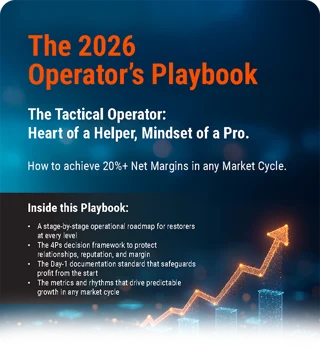
The 2026 Operator’s Playbook
How to achieve 20%+ Net Margins in any market cycle.
The winners in 2026 won’t be the ones waiting for a storm. They will be the Tactical Operators—leaders who recognize that while volume is cyclical, excellence is constant.
Meet the expert panel

Paul Donald
CEO
Encircle

Brandon Reece
CEO
FP Restoration

Josh Bachman
Business Development Advisor
Violand Management Associates

Lukas Szczurowski
Founder & CEO
Sanktume
Get complete and consistent field documentation everytime.
Learn how Encircle can help you and your field teams ease the documentation burden.